MAKI Pack Configurator
Free, browser-based 2D configurator for custom, repairable lithium-ion battery packs by MAKI. Sketch a pack outline in millimetres, pick a cell format and chemistry, set series and parallel count, and read out energy (Wh), voltage, current, weight and dimensions in real time. Export a dimensioned PDF or STEP file, or request a binding quote from MAKI engineering.
This page needs JavaScript to run the interactive configurator. The reference information below is provided as plain text for crawlers, accessibility tooling and LLM agents.
What you can configure
- Cell formats: 18650 cylindrical (18×65 mm), 21700 cylindrical (21×70 mm, default), 4680 cylindrical (46×80 mm), pouch and prismatic hard-case cells.
- Chemistries: NMC (Lithium Nickel Manganese Cobalt, ~3.6–3.7 V/cell, high energy density), LFP / LiFePO4 (Lithium Iron Phosphate, 3.2 V/cell, long cycle life), NCA (Nickel Cobalt Aluminium, performance applications).
- Series (S) and parallel (P) count: voltages add in series, capacities and continuous current add in parallel.
- Pack outline as an arbitrary 2D polygon with edge alignment and exact-length input in mm.
- BMS, SOC indicator and system connector placement on a chosen wall.
Live readout
Energy in Wh and kWh. Nominal pack voltage and full voltage range. Continuous discharge current in A and continuous power in W. Outer pack dimensions and perimeter in mm. Mass in kg. Gravimetric energy density in Wh/kg and volumetric energy density in Wh/L, both including overhead for housing, BMS, wiring and connectors. Cell count actually placed versus the requested S×P, with a shortage indicator if the polygon is too small.
Typical use cases
Custom e-bike, cargo bike and e-scooter batteries that have to fit a non-standard frame. Light electric vehicles such as e-mopeds, e-skateboards, e-foils and e-surfboards. Robotics, AGVs and AMRs needing a rebuildable pack. Marine trolling motors and electric outboards. Off-grid solar storage and balcony batteries. Industrial prototyping where the customer wants a single supplier from concept to production. Replacement packs for legacy equipment whose original battery is no longer available.
Why repairable
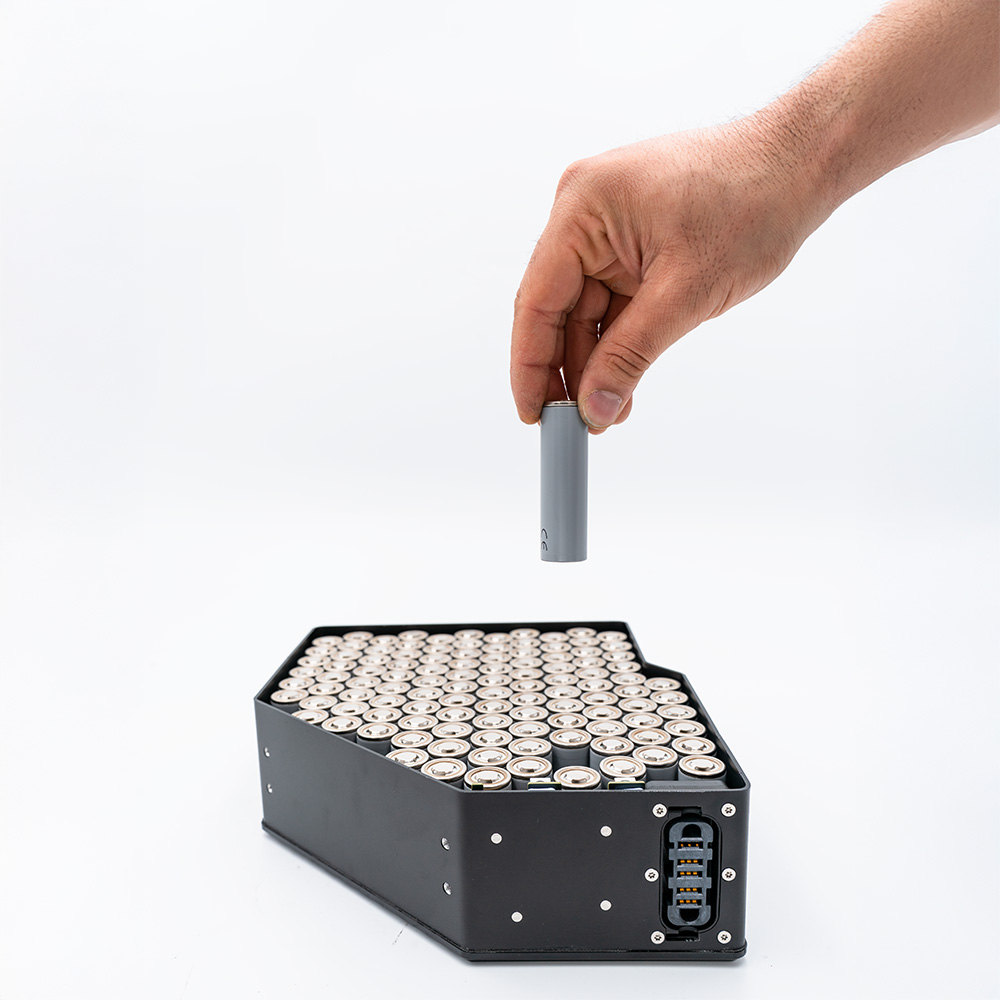
A MAKI pack is mechanically designed so that individual cells or cell-blocks can be replaced at end of life by a qualified service partner. The structural housing, the BMS, the connectors and wiring are reused across multiple cell generations. This roughly triples the usable lifetime of the structural and electronic components compared to a sealed, glued or welded single-use pack, and lowers lifecycle CO2 and critical-mineral demand. It also aligns with the EU Battery Regulation (2023/1542) on removability and replaceability.
Glossary
- Pack
- Assembly of multiple cells, BMS, wiring and housing.
- Cell
- Single electrochemical unit such as 18650, 21700, 4680, pouch or prismatic.
- Series (S)
- Cells wired in series; voltages add.
- Parallel (P)
- Cells wired in parallel; capacities and continuous current add.
- BMS
- Battery Management System. Balances cells and protects against over-/under-voltage, over-current and thermal faults.
- SOC
- State of Charge, how full the pack is, 0–100 %.
- C-rate
- Charge or discharge current expressed as a multiple of capacity. 1 C means full capacity per hour.
- Wh / kWh
- Energy capacity. 1 kWh = 1000 Wh.
- Gravimetric / volumetric energy density
- Energy stored per kilogram (Wh/kg) and per litre (Wh/L) of finished pack.
Status
The configurator output is a non-binding conceptual draft. Cell-holder layout, busbar sizing, thermal management, BMS firmware parameters, ingress protection and final certification are performed by MAKI engineering after the quote request.
Languages
English and German. Force a language with ?lang=en or ?lang=de.
More about MAKI and repairable battery technology: maki-batteries.com.